Choosing a Forklift Supplier: A Scenario-Based TCO Guide for Combilift Buyers
-
There's No Single "Right" Forklift Spec — Start With Your Scenario
-
Scenario 1: Narrow Aisles, High Density, High Throughput
-
Scenario 2: Long or Irregular Loads
-
Scenario 3: Standard Pallets, Room to Spare — Don't Overbuy
-
Scenario 4: Multi-Site or Seasonal Operations — Buy vs. Rent
-
How to Tell Which Scenario You're Actually In
-
Price Tags Are the Start of the Conversation, Not the End
There's No Single "Right" Forklift Spec — Start With Your Scenario
Almost every warehouse forklift sourcing conversation I've sat in on started the same way: pick the machine first, then figure out how to make the building work around it. That's backwards.
I've managed our material handling budget (about $240,000 annually) for six years at a 180-person logistics distribution company. I've negotiated with 20-plus forklift suppliers, and every invoice goes into our cost tracking system. If there's one thing I've learned, it's that the answer to "multidirectional or standard counterbalance?" depends on three variables: aisle width, load type, and throughput.
So before any quote makes sense, sort your operation into one of these four buckets:
- Scenario 1 — Narrow aisles, high density, high throughput
- Scenario 2 — Long or irregular loads
- Scenario 3 — Standard pallets, room to spare
- Scenario 4 — Multi-site or seasonal operations
Here's how I'd run the numbers on each one. Note: these are TCO figures, not sticker prices — and they're two very different things.
Scenario 1: Narrow Aisles, High Density, High Throughput
If your right-angle stacking aisle is under 8 feet, a standard counterbalance forklift either can't get in or has to be angled in — and angling costs you a pallet position, which costs you money every year. A typical 5,000 lb class counterbalance unit needs roughly 11–12 feet for right-angle stacking.
A multidirectional forklift cuts that footprint below 8 feet, because the forks rotate 90 degrees and let the chassis travel parallel to the racking.
But the real math is this: does the freed-up aisle width let you add a row of pallets?
In a 2024 warehouse expansion evaluation, we were quoted roughly $10/sq ft/year for leasable space. Adding about 6% more pallet positions across a 40,000 sq ft footprint worked out to roughly $24,000 per year in capacity value. The premium on a Combilift forklift over a standard counterbalance was around $60,000–$90,000 per unit (based on dealer quotes in early 2025 — verify current pricing before you commit).
That's a different story if the aisle space was already going to be empty. The multidirectional case only holds when every square foot of warehouse is either revenue-generating or earning estimated rent you can't collect.
Also factor in operator training. In a 2023 order, two operators hit racking in the first week because they weren't used to the steering geometry. Beam replacement and a stopped pick face ran us $2,100 — plus the productivity dip you don't see on any invoice. Add that to your TCO sheet.
Looking back, I should have paid for two full days of on-site operator training instead of the half-day the dealer offered. At the time, the half-day seemed like enough, given that both operators had ten years on counterbalance trucks. It wasn't (note to self: training hours belong in the TCO model, not the "nice to have" column).
Scenario 2: Long or Irregular Loads
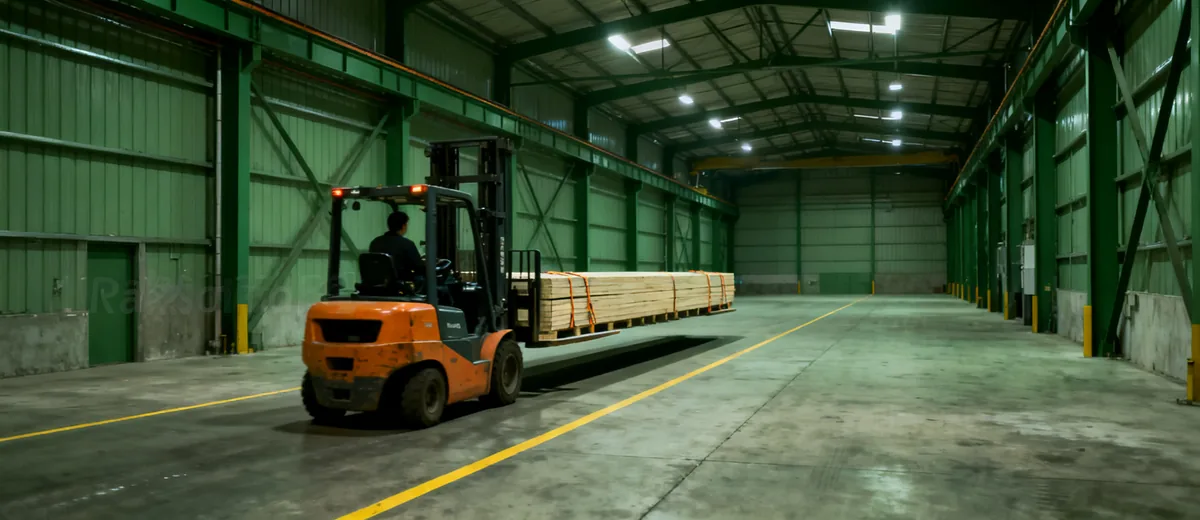
If you handle lumber, pipe, PVC extrusions, sheet metal, window frames, or prefab sections, a standard forklift paints you into an inefficient corner. You can carry the load, but your turning radius goes to pieces.
A side-loader solves that by putting the forks on the side, so the load stays parallel to the ground and the machine travels aisle after aisle. For a narrow building, that's not a nice-to-have — it's often the only realistic option.
Here the TCO math flips. I add three costs back that usually get left off the sheet:
- Product damage from ordinary forklifts making corners (we logged about $7,300 in racking and product damage over 18 months, almost all of it from turning inside tight bays)
- Double-handling, because a standard truck can't place long loads directly into the rack
- The 4–6 minutes per cycle lost to dunnage, manual assistance, and re-positioning — multiply that by operator hours over a year and it's not a small number
The flip side: if long loads are a once-a-month event, renting a side-loader or hiring a specialist handling crew is cheaper than owning one. Don't buy elasticity you can rent.
I dodged a bullet in 2022 when I double-checked a Combilift side-loader quote against our actual load list. Was one signature away from spec'ing a unit two sizes too large for our typical load profile. The heavier unit would have needed a wider aisle than our building had — the dealer assumed we'd know to check that.
Scenario 3: Standard Pallets, Room to Spare — Don't Overbuy
Here's the part some suppliers won't love me for saying: if your aisles are 12 feet wide and your loads are standard 48×40 pallets, buying a multidirectional unit or a side-loader is money spent on a capability you'll never use.
We've priced this out a few times. A standard counterbalance forklift ($32,000–$48,000, depending on battery and charger configuration), conventional racking, a basic electric stacker for low-level pick faces, and a spec'd pallet jack for trailer loading covers the operation. That last piece matters more than people think — if you already keep a pallet jack specification guide on file for load dimensions, wheel ratings, and floor conditions, the same data carries over directly to stacker selection.
The real risk here isn't picking the wrong machine. It's letting a dealer upsell you to a specialized unit because the specs are objectively better. Better specs on paper are not the same as better fit.
Sticker price is only the visible part, by the way. A 5,000 lb counterbalance rig commonly lands between $38,000 and $55,000 all-in for year one once you add service contracts, battery scheduling, and site prep (based on dealer quotes we collected in early 2025; verify current pricing).
Scenario 4: Multi-Site or Seasonal Operations — Buy vs. Rent
Most procurement teams think in terms of buy, because buying is easier to frame in a budget. But if you've got three sites with peak-and-trough demand, rental can actually win on TCO.
The case for renting: maintenance and service are usually baked into the rate, you're not carrying a technician calendar for machines that only run 600 hours a year, and you don't eat depreciation on an idle unit from October to February. The case against: the hourly cost is higher over multi-year horizons, and you lose spec flexibility.
My rule of thumb is this: below roughly 800 utilization hours a year, price rental first. Above 2,000 hours, buy. In between, run the math against your actual peak season and site count. That's not a textbook formula — it's reverse-engineered from three years of our own utilization logs. Your numbers will differ.
Never expected rental to beat purchase on a Combilift forklift evaluation. Turns out the surprise wasn't the monthly rate — it was how much we were already paying in idle depreciation and technician time across three underutilized sites.
How to Tell Which Scenario You're Actually In
This is the four-question check I use now:
- What's your tightest aisle? Under 10 feet, look hard at Scenario 1 or 2. Over 12 feet, you're probably in Scenario 3.
- Is the load standardized or irregular? Standard pallets point to Scenario 3; long stock or sheet goods go straight to Scenario 2.
- What's your peak throughput? Above roughly 25 pallets per hour, aisle efficiency starts to dominate TCO. Below 10, a general-purpose truck is usually the right answer.
- How many sites, and how seasonal? Multi-site with a real seasonal swing — start with Scenario 4 math first, then work backward.
Answer those four and your scenario mostly picks itself. Then, when you sit down with a Combilift forklifts dealer, you already know what to ask: aisle clearance, turn radius, battery duty cycle, service response time. That's a very different conversation than walking in and asking what they recommend.
Price Tags Are the Start of the Conversation, Not the End
It took me about three years to stop treating the number on the quote as the answer. What changed my sourcing process was building a TCO sheet that put rent, operator hours, rack repair, and service contracts on the same page as the invoice.
Do that, and you'll probably find what I found: the lowest quote has never once been the lowest total cost.

I’m Jane Smith, a senior content writer with over 15 years of experience in the packaging and printing industry. I specialize in writing about the latest trends, technologies, and best practices in packaging design, sustainability, and printing techniques. My goal is to help businesses understand complex printing processes and design solutions that enhance both product packaging and brand visibility.
Leave a technical comment
Do not include operational credentials, personal data or confidential facility information.