Lifecycle service boundary

Combilift Uptime Plan begins with truck failure ownership

Define the fleet boundary, service clock, access conditions, spare strategy and return-to-service evidence before availability becomes a contractual metric for multidirectional forklifts, side loaders and pallet handling trucks.

Review the Boundary
Industrial truck maintenance readiness inspection
Availability definition

Use one clock and one event classification

Fleet availability is calculated only after the measured boundary is named. The record identifies included trucks, attachments, the observation window and whether planned maintenance, lack of upstream loads, utility loss or operator delay are excluded. Mean time to repair is tracked separately from the notification clock.

Subsystem and end-to-end values may differ. A truck can be mechanically available while a traffic-system handshake fails; conversely, a steer mode can work while residual capacity is exceeded by an unapproved attachment.

Measured boundary

Named trucks, attachments, charger rooms and agreed traffic or WMS/WCS interfaces.

Observation window

Shift calendar, planned stops and the timestamp source used across equipment logs.

Event ownership

Mechanical, electrical, controls, traffic system, utility or operational process owner.

Restoration proof

Safe reset, residual capacity check, load trial and event closure accepted by the site team.

Recovery scenarios

Rehearse conditions that stop long-load flow

Scenario A

Steer-mode interlock not confirmed

Travel remains limited until the mode transition proof is restored. The plan states who inspects sensors, how overrides are authorized and which sequence re-tests aisle entry before long loads move.

Scenario B

Hydraulic or battery loss at peak

A side loader or multidirectional truck stalls during a dispatch window. Recovery requires isolation, alternate truck assignment, spare power path and a clear distinction between utility failure and equipment fault.

Scenario C

Traffic-system timeout with AMR coexistence

Tasking or zone handshakes stall. Ownership identifies the FMS, PLC or host timeout, which manual procedure remains available and how aisle priority is reconciled after restart.

Practical limitations

  • Remote support cannot replace on-site access where guarding, batteries or hydraulic assemblies must be opened.
  • A target response time does not equal restoration time when site permits, specialist parts or unavailable spares control the path.
  • System availability targets do not remove the need for planned inspection, tire programs and operator competence checks.
  • Functional safety and performance level (PL) claims remain model- and configuration-specific; they are not transferred by brand name alone.
  • Fleet management system or WCS handshakes cannot restore residual capacity when an unapproved attachment changes the load center.

Fixed automation vs flexible robotics beside truck fleets

Fixed automation argument: Deterministic conveyors and AS/RS can raise pick rate when SKU velocity is stable, but they still need industrial trucks for exceptions, long loads and brownfield docks.

Flexible robotics argument: AMR/AGV fleets adapt layouts faster, yet coexistence with multidirectional trucks requires safety laser scanner fields, traffic rules and SAT scripts—or peak waves absorb hidden conflict time.

Combilift Uptime Plan coverage for trucks does not replace either architecture; it documents mean time to repair and system availability for the truck boundary you choose to measure.

Spares and response

Stock by aisle failure exposure, not by part count

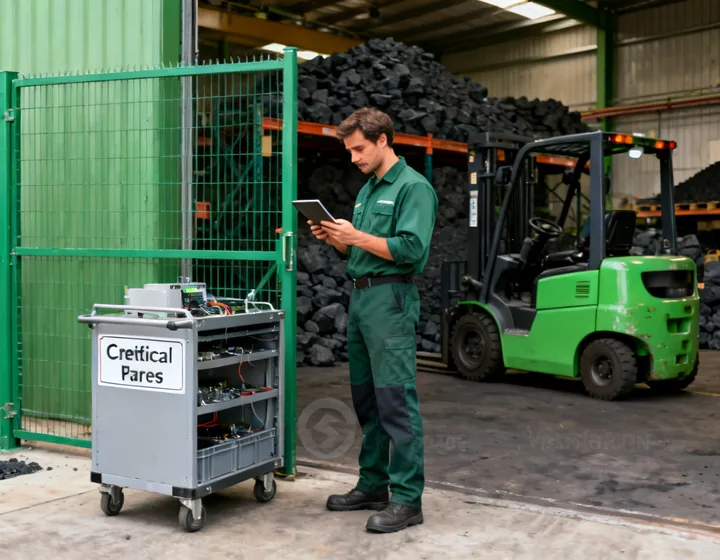
A critical-spares matrix links each item to installed quantity, failure effect, diagnostic confidence, lead time, shelf-life or storage condition, replacement competence and commissioning step. It distinguishes consumables from parts that can remove a meaningful fraction of long-load capacity.

ClassTypical basisReadiness evidence
Site stockHigh consequence or long replenishment lead timeLabeled location, preservation check and compatible revision
Regional stockShared hydraulic or steer component with predictable transportDispatch owner, cutoff time and customs boundary
Repairable assemblySpecialist rebuild and controlled exchangeReturn authorization, test method and configuration record

Response clock checkpoints

  1. 0: site logs truck, alarm, state and impact
  2. 1: support confirms ownership and safe diagnostic path
  3. 2: parts, access and personnel route are agreed
  4. 3: repair is verified with a defined load trial
  5. 4: event record closes with root cause and action
Readiness evidence

Connect each Uptime Plan commitment to a document and a test

Request an Uptime Review
Design Rate

Peak moves tied to named SKU and aisle assumptions.

FAT

Factory proof for capacity, steer modes and safety devices.

SAT

Live-aisle acceptance with floor and interface owners.

Service Response

Escalation clock and spare ownership before release.